Flakes
Python: "map_flakes"
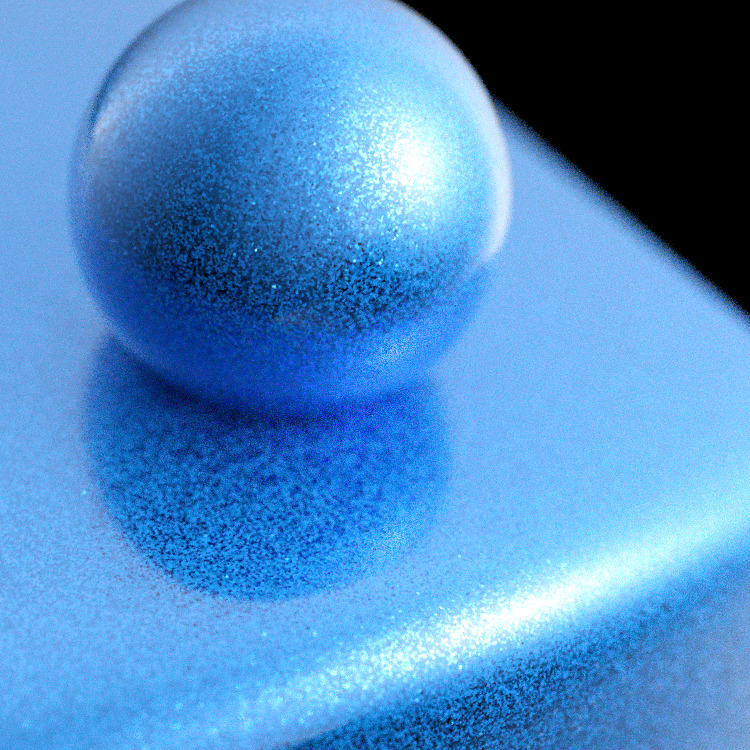
The flakes map produces a soup of flat tiny shards which can be used to simulate materials such as carpaint. The map issues multiple outputs suitable to control a standard material, all stemming from the same flakes distribution.

Common
Node alias
Python: "map_alias"
Human-readable node alias.
Alias color
Python: "map_alias_color"
Identificative node color.
Swap colors
Python: "map_color_swap"
Swaps the primary and secondary colors.
Primary color
Python: "map_color_1"
Defines the primary (background) color. The lower end of the output signal range is remapped to this color.
Primary color map
Python: "map_color_1_map"
Defines the primary color using a texture map.
Secondary color
Python: "map_color_2"
Defines the secondary (foreground) color. The upper end of the output signal range is remapped to this color.
Secondary color map
Python: "map_color_2_map"
Defines the secondary color using a texture map.
Main
Density
Python: "map_flakes_density"
Defines how far apart individual flakes tend to be. Higher values produce a sparse distribution, and lower values produce a dense distribution.
Density map
Python: "map_flakes_density_map"
Controls the flakes density using a grayscale texture map.
Normals randomness
Python: "map_flakes_normals"
Defines the overall randomness of flakes in the normals output plug. Lower values tend to align the flakes with the host surface. Higher values allow the flakes to be randomly oriented.
Normals randomness map
Python: "map_flakes_normals_map"
Controls the randomness of flakes normals using a grayscale texture map.
Roughness low
Python: "map_flakes_roughness_lo"
Defines the lower limit of the output roughness range. This value affects the roughness output plug, only.
Roughness high
Python: "map_flakes_roughness_hi"
Defines the upper limit of the output roughness range. This value affects the roughness output plug, only.
Randomize
Python: "map_randomize"
Random number seed used to randomize the map. Each possible seed produces a distinct version of the map.
UV transform
Transform map
Python: "map_xform_map"
Allows to connect an xform_2d/3d/spherical map to control the texture tiling, position and rotation.
Coordinate space
Python: "map_xform_space"
Defines whether the map issues its own volumetric (object or world) mapping coordinates for seamless 3D tiling, or uses the existing object UVs. The instance UVs mode is applicable to instances (e.g., in scatter) and plucks the UVs of the base at the instancing point.
Crop U (low)
Python: "map_xform_crop_x_lo"
Lower limit of the UVW space in the U direction.
Crop U (high)
Python: "map_xform_crop_x_hi"
Upper limit of the UVW space in the U direction.
Crop U direction
Python: "map_xform_crop_x"
Shrinks the UVW space to a non-unitary interval along the U direction.
Crop V (low)
Python: "map_xform_crop_y_lo"
Lower limit of the UVW space in the V direction.
Crop V (high)
Python: "map_xform_crop_y_hi"
Upper limit of the UVW space in the V direction.
Crop V direction
Python: "map_xform_crop_y"
Shrinks the UVW space to a non-unitary interval along the V direction.
Crop W (low)
Python: "map_xform_crop_z_lo"
Lower limit of the UVW space in the W direction.
Crop W (high)
Python: "map_xform_crop_z_hi"
Upper limit of the UVW space in the W direction.
Crop W direction
Python: "map_xform_crop_z"
Shrinks the UVW space to a non-unitary interval along the W direction.
Master repeat
Python: "map_xform_repeat"
Inverse scale the map is generated at. This parameter pre-multiplies the X/Y/Z repeat values. Note that local/world spaces tile at 1mx1mx1m by default.
Repeat U
Python: "map_xform_repeat_x"
Repeats the map along the X/U axis. Increasing this value increases repetition.
Enable U repetition
Python: "map_xform_tile_x"
Allows map repetition along the X/U axis. When disallowed, the map becomes zero outside the [0..1] (or cropped) X/U interval.
Clamp vs. repeat (U)
Python: "map_xform_clamp_x"
Toggles between clamped vs. repeated output outside the [0..1] (or cropped) X/U interval.
Repeat V
Python: "map_xform_repeat_y"
Repeats the map along the Y/V axis. Increasing this value increases repetition.
Enable V repetition
Python: "map_xform_tile_y"
Allows map repetition along the Y/V axis. When disallowed, the map becomes zero outside the [0..1] (or cropped) Y/V interval.
Clamp vs. repeat (V)
Python: "map_xform_clamp_y"
Toggles between clamped vs. repeated output outside the [0..1] (or cropped) X/V interval.
Repeat W
Python: "map_xform_repeat_z"
Repeats the map along the Z/W axis. Increasing this value increases repetition.
Enable W repetition
Python: "map_xform_tile_z"
Allows map repetition along the Z/W axis. When disallowed, the map becomes zero outside the [0..1] (or cropped) Z/W interval.
Clamp vs. repeat (W)
Python: "map_xform_clamp_z"
Toggles between clamped vs. repeated output outside the [0..1] (or cropped) X/W interval.
Translate U
Python: "map_xform_translate_x"
Offsets the map along the X/U axis.
Translate V
Python: "map_xform_translate_y"
Offsets the map along the Y/V axis.
Translate W
Python: "map_xform_translate_z"
Offsets the map along the Z/W axis.
Rotate U
Python: "map_xform_rotate_x"
Rotates the map about the X/U axis. Positive values rotate the map counter-clockwise.
Rotate V
Python: "map_xform_rotate_y"
Rotates the map about the Y/V axis. Positive values rotate the map counter-clockwise.
Rotate
Python: "map_xform_rotate_z"
Rotates the map about the Z/W axis. Positive values rotate the map counter-clockwise.
UV distortion
UV distortion map
Python: "map_distortion_map"
Internal use.
Enable UV noise
Python: "map_distortion_noise_enable"
Toggles noise distortion in the UVW space on/off.
Noise amount
Python: "map_distortion_noise"
Amount of noise distortion applied to the UVs before they are used.
Noise size
Python: "map_distortion_noise_size"
Amplitude of the noise distortion. This value is given in UVW space. E.g., 0.1 means that the maximum distortion is about 1/10th of a 1x1x1 texture tile.
Noise octaves
Python: "map_distortion_noise_octaves"
Number of times the noise algorithm overlaps onto itself to add high-frequency details.
Noise randomize
Python: "map_distortion_noise_randomize"
Random number seed used to randomize the distortion.
Enable jitter blur
Python: "map_distortion_blur_enable"
Toggles jitter blur in the UVW space on/off.
Jitter blur radius
Python: "map_distortion_blur"
Amount of 2D gaussian (jittering) blur applied to the UVs before they are used. This value is given in UVW space. Note that this type of blur may cause sampling noise that takes long to dissolve. Note also that jitter blur does not produce gamma-correct results, and can't be used for bump or displacement height maps.
UV scattering
UV scattering map
Python: "map_scattering_map"
Internal use.
Enable random offset
Python: "map_scattering_offset_enable"
Internal use.
Offset U
Python: "map_scattering_offset_x"
Internal use.
Offset V
Python: "map_scattering_offset_y"
Internal use.
Randomize
Python: "map_scattering_offset_randomize"
Internal use.
Enable random tiling
Python: "map_scattering_tiling_enable"
Internal use.
Blend
Python: "map_scattering_tiling_blend"
Internal use.
U splits
Python: "map_scattering_tiling_x"
Internal use.
V split
Python: "map_scattering_tiling_y"
Internal use.
Rotate splits
Python: "map_scattering_tiling_rotate"
Internal use.